Spielberg's Alien Film Is Only Okay -- But It's Important. And It's Something Close To Evil
Rod Dreher | June 15,
2026
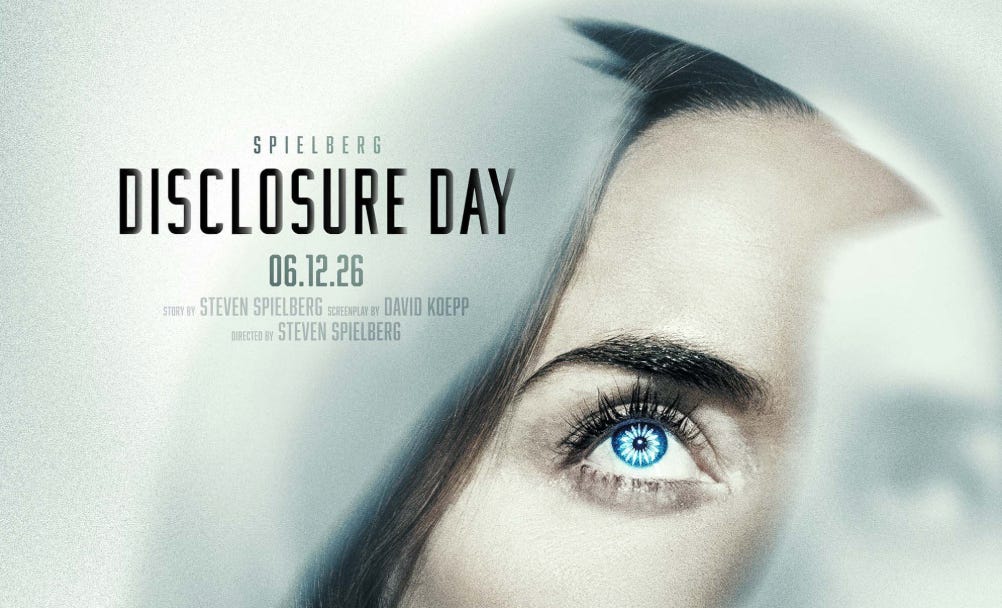
On Saturday night I saw Steven
Spielberg’s Disclosure Day. Reviews have been generally
positive, though audience reaction is more mixed. It was startling to see a big
suburban theater on opening weekend, the first showing Saturday night of a
much-hyped Spielberg movie, only half full. Make of that what you will.
Disclosure Day is a
film about re-enchantment. More to the point, it’s a film about false
enchantment, though I am certain the filmmakers don’t see it that way. It is a
profoundly religious film. It is also, I believe, profoundly evil.
Nevertheless, I strongly recommend seeing it, because it plays like a prophecy
of the great deception that I believe will sooner or later present itself to
us. You need to know this.
Let me explain.
Jacques Vallée’s Warning
First, this important background.
Jacques Vallée, now 86, is probably the most important person in the UAP world,
and has been for decades. He is a computer scientist by training, and for
decades a venture capitalist. He got into investigating the UAP phenomenon many
decades ago, in part because he saw a UAP in 1955, but then out of scientific
curiosity. He is not a religious believer, but he also could not accept that so
many reports of bizarre encounters and sightings of what popular culture
construed as “aliens” could be made up.
Nor could he accept that whatever
these things are, that they are creatures from other worlds. He theorizes — and
he’s careful to say that these are only hypotheses — that whatever it is, it
is both a material and non-material phenomenon, one that blurs
lines between science and technology on one hand, and religion and
consciousness on the other.
In his seminal 1969 book Passport
To Magonia,
(https://archive.org/details/passporttomagoni0000vall_m8g5),
Vallée argues that this
phenomenon is simply a recycling of one that has been with humanity for a very,
very long time, but presents itself to us as “aliens from space,” because that
is how people in a scientific-technological age are predisposed to receive
them. In one of his later books, Messengers Of Deception
Vallée contends that
I have found
disturbing evidence of dangerous sectarian activities linked to totalitarian
philosophies. The ease with which journalists and even scientists can be
seduced into indiscriminate promotion of such deceptions is staggering. In the
context of an academic attitude that rejects any open investigation of
paranormal phenomena, such fanatical conversions must be expected.
… Many people
around us today are preparing to greet it with delight, even if that means
falling under the control of forces they do not understand. These people are
the UFO contactees and the believers in celestial visitation, the followers of
the saucer prophets. They can pave the way for dramatic changes.
Vallée — writing in 1979 —
pointed to the slow but steady collapse of the public’s faith in institutions
and social structures, and the fragmentation of knowledge:
… This isolation
of knowledge is matched by the failure of other social structures. Here, too,
the parallel with ancient Greece is interesting. In Five Stages of Greek
Religion, Gilbert Murray mentions that in Greece there was gradual awareness of
two failures:
... the
failure of human government, even when backed by the power of Rome or the
wealth of Egypt, to achieve a good life for man; and the failure of the great
propaganda of Hellenism, in which the long-drawn effort of Greece to educate a
corrupt and barbaric world seemed only to lead to the corruption and
barbarization of the very ideals which it sought to spread.
Under these
conditions - so similar to those of the Western world today, in which human
government is regarded with suspicion and in which education of the
"emerging nations" by the affluent ones is nonexistent - what did the
Greeks do?
This sense of
failure, this progressive loss of hope in the world, in sober calculation, and
in organized human effort, threw the Greek back upon his own soul, upon the
pursuit of personal holiness, upon emotions, mysteries, and revelations, upon
the comparative neglect of this transitory and imperfect world for the sake of
some dream world far off.
A dream world
far off — that is exactly what the UFO contactees are offering us when
they invite us to step into a pleasant mirage, to reprogram our consciousness.
This is precisely what Disclosure
Day does. Vallée — he was the model for the French scientist in
Spielberg’s Close Encounters of the Third Kind — has
repeatedly warned over the years that Hollywood has labored for decades to
condition the public to accept UAPs (or, as we used to say, UFOs) as bearers of
peace and salvation. He writes in Messengers (again, this
first came out in 1979):
Let me summarize
my conclusions thus far. UFOs are real. They are physical devices used to
affect human consciousness. They may not be from outer space. Their purpose may
be to achieve social changes on this planet, through a belief system that uses
systematic manipulation of witnesses and contactees; covert use of various
sects and cults; control of the channels through which the alleged "space
messages" can make an impact on the public.
Whether Spielberg intends it or
not, Disclosure Day proclaims a new religion, one that
displaces Christianity (at least). It’s hard to believe that this is an
accident. To be charitable, we could assume that Spielberg, no longer able to
believe in the God of the Bible, and of his Hebrew ancestors, has transferred
his hopes to aliens. That is the gospel he preaches in this film.
The Film’s Twisting Of
Christian Symbolism, And Occultism
I’m going to try to do this
without giving away too many spoilers. I’m pretty sure I will fail, so if you
want to drop off here, do, and come back later, after you’ve seen the movie.
Still, I’m going ahead because it’s very important to get this stuff clear.
The film’s set up has Daniel
Kellner (Josh O’Connor), a rogue engineer who steals extremely classified data
— footage, in particular — from Wardex, a private company contracting with the
US Government to maintain and secure military footage from UFO crashes,
including encounters with “greys” — the bulbous-headed aliens usually observed
to contactees (or, in the film’s lingo, “experiencers”). Kellner is part of a
conspiracy of Wardex whistleblowers who have stolen the master cache, and are
trying to get it to a Kansas City TV station, to broadcast to the world.
He crosses paths with Margaret
Fairchild (Emily Blunt), a Kansas City TV weather broadcaster who, after having
a mysterious encounter with a red cardinal (bird) who flies into her house,
finds that psychic powers have been activated inside her. She can speak foreign
languages fluently, and can read people’s minds. The friend who saw the movie
with me, a theologian, noted that this is a kind of Pentecost, when the Holy
Spirit descended on the worshipers, and they spoke in foreign tongues. The
Apostles performed signs and wonders. Here is Act Chapter Two:
https://www.biblegateway.com/passage/?search=Acts%202&version=NIV
Read it, and know that in Disclosure
Day, Fairchild gains these gifts after a visit by a bird. (Perhaps I need
to point out to my non-Christian readers that the Holy Spirit is traditionally
symbolized by a bird.)
The movie is above all a chase
film. Fairchild and Kellner meet up and try to stay one step ahead of Noah
Scanlon (Colin Firth), the CEO of Wardex, and as such, the chief Keeper of the
Secrets. The religious element of the film has to do with why Scanlon is
persecuting Fairchild and Kellner: because he believes that if the information
gets out, the world will fall apart, because the masses cannot handle the
knowledge.
Early in the film, Daniel and his
girlfriend Jane (Eve “Daughter of Bono” Hewson), a former nun, take refuge in a
convent. Jane was a postulant there, but left because she lost the ability to
believe in the truths proclaimed by the Catholic faith. Yet when Daniel reveals
to her what the secrets he’s guarding are, she initially argues against
disclosure, saying something to the effect that (false) belief in God is what
gives people meaning and cohesion. She exclaims angrily, “People have been
raised to believe in a supreme being, and now you want to show us actual
supreme beings? The world can’t handle both.”
Note the theological elision
here: the assumption that aliens would be received by humanity as gods. I
believe this is an accurate assumption, at least in the
Christian world, in an era in which there has been a catastrophic loss of faith
among many, and a loss of theological and doctrinal knowledge among many of
still believe. Aliens (“aliens”) descending from spaceships to proclaim new
truths to us would be rather more persuasive to the masses today than the
watery god of Moralistic Therapeutic Deism, wouldn’t you say?
From a purely abstract point of
view, I see no serious problem within Christianity to accommodate unknown
entities within the order of created being. Disclosure of extraterrestrials, if
they exist (which I don’t think they do), would not shake my faith in the
slightest, and shouldn’t shake a well-catechized Christians.
But we do not live in a world of
well-catechized Christians. We see later in the film that a pious nun, dressed
conservatively (not Sister Stretchpants), asserts that nothing in the Bible
says that Man is God’s highest creation in the cosmos — only on the earth, she
said. Well … yes, insofar as angelic beings are also part of the created order,
and the Bible says man is “a little lower than the angels.” There could be
other, unseen beings. Mother Superior is not entirely wrong, but the way she
presents this claim is in context of convincing Jane to integrate the aliens’
existence into her Christian worldview. The unspoken assumption is: they
come in peace to enlighten us, so what’s the problem? Welcome them as
messengers.
Spielberg himself has said that
the movie’s message is that if we are going to avoid war (note that the alien
drama happens as the globe approaches the brink of World War III) and conflict,
then we need to rediscover empathy. Well, if this movie were telling us that we
need to rebalance our brain hemispheres, à la the works of Iain McGilchrist, I
would be on board. But that’s not what it’s saying.
The aliens of the film are trying
to teach us to be more empathetic. So, I guess this is why they kidnap and
traumatize children in the night, violate their bodies, and leave them with
extremely painful memories? (This happens in the film.) As Vallée has
extensively documented, no “aliens” who meant humanity well would treat us as
these things have done. Something real is going on here, but these aren’t
intergalactic ambassadors of Up With People.
Disclosure Day is a
film about Gnosticism — that is, the ancient and most durable Christian heresy,
one that says salvation comes from knowledge, or knowing secret teachings.
There were a number of Gnostic sects during the early Christian period, but
what they generally held in common was that one would find salvation not from
faith, good works, participating in the sacraments and the life of the Church,
but rather from gaining occult (hidden) knowledge about the way the cosmos is
constructed, and what one’s individual purpose is in life. In Gnosticism, one
doesn’t depend on Authority, but experiences the Truth within.
Now, in Disclosure Day —
and I definitely cross the line into spoilers here, so if you’re super-strict
about avoiding them, stop reading — we see Margaret and Daniel fleeing
persecution so they can Know The Truth: the truth about themselves, and
reality. Indeed, both (but especially Margaret) receive infused knowledge from
the non-human entities — just like “Tyler D.” (Tim Taylor) and “Simone”
(Planté) in Diana Pasulka’s books. These spiritual “gifts” are bestowed not by
God but by these NHIs (non-human intelligences), and are meant to assist their
receivers in their mission.
But Daniel has stolen the Secret
Knowledge about the Aliens from its caretakers, and risks his life to reveal
the truth to all humanity. Margaret is to be its prophet, proclaiming it to the
world, via global electronic media.
I thought of Marshall McLuhan’s
statement decades ago. I quote it in this passage from my book Living In
Wonder (which, if you haven’t read now, come on, before events
compel you to, to better understand what’s actually happening):
When Marshall
McLuhan, a Catholic who went to daily Mass, said that the age of electronic
media favored the appearance of the Antichrist, his secular admirers had no
idea what to make of it. What did electronic media have to do with the book of
Revelation’s prophecy that in the last days a fearsome false messiah would
appear? There are two reasons for this, he said.
First: “Electric
information environments being utterly ethereal fosters the illusion of the
world as spiritual substance. It is now a reasonable facsimile of the mystical
body [i.e., the church], a blatant manifestation of the Antichrist.” McLuhan
meant that the light that passes globally through electronic networks that
connect humanity is a physical counterfeit of the doctrine that all Christians
are mystically linked into a single world community through faith in Jesus
Christ, the true Light of the World. McLuhan indicated that electronic media
(TV and radio, in his time) made people feel that all peoples were part of the
same community; had he lived to see the internet, his insight would have been
utterly vindicated.
Second: “When
electricity allows for the simultaneity of all information for every human
being, it is Lucifer’s moment… Just think: each person can instantly be tuned
to a ‘new Christ’ and mistake him for the real Christ.” This claim is easier to
understand. If everyone around the world is online—and, as of 2024, an
estimated 66 percent of the world’s population has internet access—it becomes
possible for the first time ever to send commands around the world
simultaneously.
In the film’s climax, the entire
world lays down its guns simultaneously, and picks up its smartphones, to
experience the New Revelation Of Truth, broadcast to the entire planet at the
same time. This is technologically feasible now. McLuhan warned us. And now
it’s here.
The attentive viewer realizes
that Margaret and Daniel are Adam and Eve for the New World Order. They play
out a reversal of Genesis. Remember this?
And the LORD God
commanded the man, “You may freely eat of every tree of the garden; but of the
tree of the knowledge of good and evil you shall not eat, for in the day that
you eat of it you shall die.” [Genesis 2:16-17]
In Disclosure Day, things
are reversed. If you don’t eat of the tree of the knowledge of good and
evil (symbolically), then you shall die in a nuclear conflagration. The
God figure, Wardex CEO Scanlon, is actually portrayed as the Satan, the
Adversary who wants to maintain control by preventing people from knowing the
Truth.
As part of the initiation process
— sort of like a rite of confirmation, where the seeds planted in baptism come
to fruition — Margaret and Daniel have to revisit the extremely traumatic
nights in childhood when they were seized by the aliens and taken somewhere
else.
This is the creepiest, most
wicked part of the film. The more I think about it, the sicker it seems —
though I’m sure most people will not receive it this way.
Margaret returns in a lucid dream
sequence, triggered by alien technology, to her childhood bedroom, where she
lies awake at night, singing a song from the Disney film Cinderella:
“Someday My Prince Will Come”. Suddenly friendly animals appear at the foot of
her bed, beckoning her to join them — just as Cinderella had an intimate
relationship with animals. We are told in the film that the aliens — the
hideous bulbous-headed greys — disguised themselves as animals so as not to
frighten the children. (By the way, here
is the 1918 drawing the occultist Aleister Crowley made of the demon Lam he
conjured in a ritual.
https://commons.wikimedia.org/wiki/File:Supposed_channeled_entity_by_occultist_crowley.jpg
Look familiar?)
The fake animals lead Margaret to
“Hansel and Gretel’s house,” which is how the alien spaceship is disguised to
trick the children. Yes, that metaphor is on the nose in the same way Ali’s
fist was on Frazier’s schnozz … but worse, don’t you remember that in the
Grimm’s fairy tale, this house was the witch’s lair, which she disguised as a
gingerbread house to lure the innocent children to their destruction? But in
Spielberg’s fairy tale, it is a place of wonder, welcome and transformation of
the innocent children. Never more clearly does Disclosure Day reveal
its true intent than in this sequence.
The aliens implant something in
the children through their left eyes. Not both eyes: their left
eye. This is not a storytelling accident. If you want to go down a
frightening rabbit hole, check out this website’s explanation of the “single
eye,” its occult meaning throughout esoteric history, and its tracking of how
the image keeps showing up in popular culture, especially via contemporary
celebrities.
(https://vigilantcitizen.com/vc-resources/the-one-eye-sign-its-origins-and-occult-meaning/)
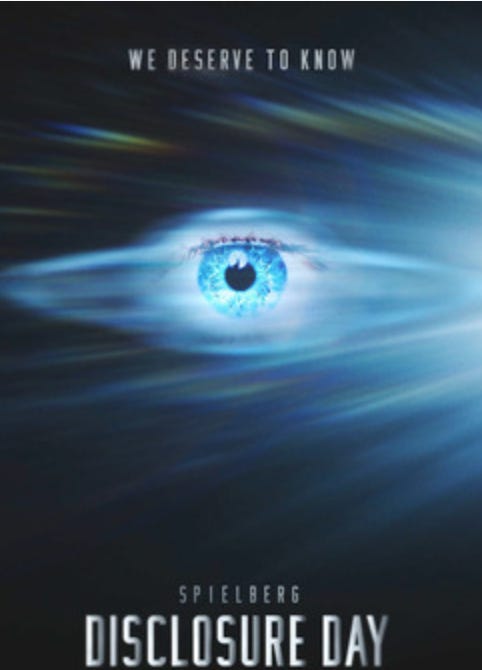
The lone eye is a big part
of Disclosure Day’s marketing. Look at the poster at the top of
this essay. Look at this one:
Through this knowledge implanted
by violating the bodies of innocent, kidnapped children, the aliens
create prophets to prepare the world for its coming transformation into
creators of a world of peace, love, and universal empathy. They will deliver
humanity from war and destruction in this way. This is what Bible warns about
the Antichrist, who will come as a man of peace, producing signs and wonders to
temporarily calm the bellicose and traumatized world, and seduce the masses
into following him. In Disclosure Day, the Mother Superior
indirectly grants her imprimatur to the aliens and their message, telling Jane
that she, as a failed nun, had not lost her faith in God, but in people. In
other words: “You didn’t think humanity could handle the ultimate Truth of the
New Revelation, but you were wrong. Calm down. This is part of God’s plan.”
To step back for a moment, I
actually favor disclosure, but not because I believe the
“aliens” have a liberating message for humanity. I believe we need to confront
the truth, come what may — even if it is part of what Christians anticipate
will be the Great Deception immediately preceding the Apocalypse. Government
secrecy is only leaving the masses vulnerable to the allure of forbidden
knowledge, and is preventing us from developing defenses against whatever this
thing is. (If you don’t believe me because I’m a Christian, then for heaven’s
sake, read Jacques Vallée — who, note well, recommended to Diana Pasulka on a
personal visit a few years back that she read a collection of mid-century
Catholic theological essays about the nature of Lucifer, saying that this might
have something to teach us about the phenomenon.)
But Disclosure Day is
a lie. A big and consequential lie. Fortunately the film is not top-flight
Spielberg, in terms of storytelling, so it won’t be as popular as it might have
been. I think audiences might go into the film thinking that they’re going to
see something flash-bang-pew-pew, like the popcorn-film alien invasion
blockbuster Independence Day. It’s very much not that. It’s
not a bad night at the movies, but it does play as shallow, sappy Boomer
sentimentalism. There is a good film to be made about disclosure, and the
philosophical, religious, and anthropological questions it would raise (Vallée’s
writing is a good place to start for source material) — but Spielberg’s movie
is definitely not the one. It is simply bizarre that Spielberg would reproduce
the kind of intense trauma testified to by many “experiencers” as something
beneficial — especially when it involves (in the film) kidnapping and violating
the bodies of innocent children. Read the cultural room, Steve!
I had wondered why Kansas City
plays such a big role in this film. On the way out of the theater, my
theologian friend pointed out that the Midwestern city is where Walt Disney got
his start. He grew up there, started his first animation studio there. Kansas
City is where the man who more than any other engineered and enchanted the
imaginations of generations of American children got his start. This, plus the
inclusion of a Disney Studios-owned song (from “Cinderella”) in a picture made
by a rival studio, shows you the symbolism at work here. Spielberg plainly
intends Disclosure Day to be about the re-enchantment
of humanity — the rediscovery of meaning, purpose, and magic — via adult fairy
tales about aliens coming bearing gifts of universal peace.
Butterflies are key symbols
in Disclosure Day. Butterflies, in general, are symbols of
transformation into a higher state. Child Margaret grows up in a bedroom with
wallpaper covered with butterflies. Adult Margaret wears a pendant with a
single butterfly wing, a symbol of the deep and inexplicable sense of
incompleteness, and purposelessness, that has been her burden prior to the
drama of the film, she has been yearning for completeness. It all makes sense
by the end. We even see a secret government film of a giant alien ship
resembling a butterfly taking off. The message of the film is: the
aliens are coming to transform us, to make us into higher beings. We should
welcome them, and do as they say.
And, not to put too fine a point
on it, near the end, when Margaret is about to re-live her trauma experience, a
sympathetic woman approaches her and makes the sign of the cross. Margaret, who
can read minds at that point, understands that the woman wants her to become a
Catholic. She draws back in horror, runs, and, as she slams the door of her
fake house, says out loud, “I am not anybody’s religion!”
Of course not. She’s the false
prophet of the new one.
So: if Disclosure Day is
so middling a movie, and its message is so anti-Christian, why do I recommend
that discerning Christian readers see it? Because you will never see so blatant
an instantiation of the kind of propaganda that I believe will become more and
more present as the world moves forward towards whatever climax is coming.
Again, Vallée’s point is crucial.
We are living through a time of a massive shift in consciousness — this time,
not just a civilizational one, but perhaps even a global one. Here in the West,
as I’ve written about in my last three books, and will come at again in next
year’s Weimar America, we have been sloughing off our
ancestral religion for the last two centuries, and with it the “myth” (in the
anthropological sense) that provides the unspoken framework of who we are, what
our purpose is, and how the cosmos is made. This is what I mean by disenchantment.
People cannot bear too much
disenchantment. Read your Michel Houllebecq, one of the secular master
diagnosticians of our era. Only a world that has been cleared of the old
religion(s) will find the new one proposed to us to be plausible. You might
claim that Europe is largely godless, and so is Canada, but not us in the
United States. This is simply not true.
It is inarguably the case that
America is more religiously observant than other Western countries — I have
been living that out since I returned to the states three weeks ago, and thank
God for it! — but as I have written in The Benedict Option (most of
all), but also in Live Not By Lies, in Living In Wonder, and in
the forthcoming Weimar America, our Christianity is heavily watered down by any
historic measure, mostly cultural, and easily malleable. This is why the
sociologist of religion Christian Smith says that the actually existing
religion of younger Americans (and I would say many older ones too) is Moralistic
Therapeutic Deism.
Most of us do not have the
spiritual and imaginative antibodies to resist the appeal of the Gnostic
re-enchantment offered by the aliens-as-redeemers narrative. In Living
In Wonder, I tell the story of “Jonah,” an American academic I met
through his exorcist. Jonah was deeply involved in the occult, thinking he was
worshiping “ancient gods” suppressed by evil Jews and Christians, until he
realized that no, these were actually demons. He fled, and converted to a
strong form of Christianity. In my book, Jonah recalls being a smart, curious
kid growing up in suburban Evangelicalism, and his pastor having no real
answers for the deep questions he was asking. So, out of curiosity to
know, he read himself into esotericism, and eventually became a
full-blown occultist, worshiping as part of a large community of others — some
of them intellectuals, including other academics — who really believed that
their religion was destined to displace the dying Christianity.
You, reader, might be able to
watch Disclosure Day and spot the obvious problems and
deceptions in its narrative. But it is extremely unlikely that most Christians
you know can. They will be taken in by the pious older nun who appears serene
in the face of disclosure, without questions about what the aliens claim, and
what challenges they pose to Biblical truths. After all, if religion is about
nothing more than increasing our love and empathy, then why not? It is no
accident that the movie’s villain, Scanlon, is an older white man who wishes to
hoard knowledge for himself, on behalf of the government, corporations, and
power structures — and the liberators are a strong woman (Margaret), and Hugo,
a black man who orchestrates the disclosure plot.
Colman Domingo, the actor who
plays Hugo, was recently asked by Variety if he believes in aliens:
“I absolutely
do,” he answers. “And I don’t know what they look like, what they feel like,
what their objectives are, but I do believe that there has to be more. It can’t
just be us.”
He adds, “I
mean, I stand outside, look at the stars, believing that someone’s staring back
at us, and at some point we’ll come together. So I believe that with whatever
the unknown brings to us, maybe it’ll be good for all of us.”
This vacant, well-meaning
receptivity is where most Americans are today, I think. Look at the numbers in
this recent CBS News poll. Excerpt:
The percentage
who believe intelligent life exists on other planets has become more widespread
in recent years. Looking back just to 2010, fewer than half of Americans
believed that. Since that time, higher numbers of men, women and people across
age groups and education levels now believe in the existence of intelligent
life.
https://www.cbsnews.com/news/americans-believe-extraterrestrial-life-exists-opinion-poll/
That same poll found that nearly
one in five Americans has seen what they believe to have been a UFO. That’s
approximately 59 million people — a massive number. Sure, you could say that
what they saw was something that could be explained, though how you or I would
know this is a leap of faith. The point is not whether what an individual saw
was real or not; the point is that they believe it was a UFO. This
tells us something important about their mindset.
A Catholic professor friend of
mine told Marc Andreessen once that a medieval peasant, with his religious
belief and superstitions both, is better able psychologically to cope with the
world of Artificial Intelligence than contemporary man is. Why? Because he
assumed that the cosmos contained other, non-human intelligences, and he
believed as a matter of course that there were proven ways to deal with them.
We moderns have stripped ourselves of this knowledge, and as such, are
vulnerable. To be clear, this professor was not saying AI is alien tech; he’s
simply saying that in the modern era, we are psychologically disoriented by the
very concept of non-human intelligence.
The same point can be made about
how we can and will cope with disclosure. I can’t speak for believers in other
religions, but well-informed and discerning Christians will approach the topic
with great prudence and skepticism — not the kind of skepticism that says “this
can’t be real,” but the Valléesque skepticism that says, “This is real — but
what is it? What is its nature? What does it want from us? What does it want to
do to us?” And so forth. In the documentary The Age Of Disclosure,
Lue Elizondo and other whistleblowers talk about high-ranking Pentagon
officials who discouraged investigation on grounds that this phenomenon is
Satanic
(See here: https://www.youtube.com/watch?v=sjmJmwsjdGI&t=256s).
I believe this is true — that
there have been and are people in authority who have acted this way — but at
the same time, I don’t believe that refusing to look is a wise course of
protecting ourselves from a phenomenon that I too believe is ultimately Satanic.
So: parents, priests, pastors,
religious leaders all need to see Disclosure Day. It is a
fairy-tale of re-enchantment for a Gnostic, occultic, scientific-technological
era. Whatever Spielberg’s limitations as a storyteller in this film, he has
produced a near-perfect example of the kind of false and deceptive story that
we will all be led to believe in the Age of Antichrist. We have to have
strong, well-informed answers to counter these stories, so we and the people
who depend on us for leadership will not be deceived. The hard-line
skeptical materialist response grows less credible by the day.
Though I don’t agree with all the
theological material in this two-part interview between the Catholic exorcist
Fr Dan Reehil and Daniel O’Connor, a Catholic author of a book about UAPs and
Antichrist, I can confidently recommend their discussion to you. Part One on
YouTube here:
https://www.youtube.com/watch?v=_fNTO39rftY&t=1437s
Part Two is here:
https://www.youtube.com/watch?v=YtDIMqG0FQ4
Note especially Fr Reehil’s point
that some people claim “aliens” can’t be demons, because the spacecraft are
nuts-and-bolts machines. He points out that we know from Scripture that angels,
immensely powerful spiritual beings, can manipulate the material world — and
demons are fallen angels. Plus, Fr Reehil makes a point I’ve heard from other
exorcists: if you have enough experience with this, you have seen it happen
with your own eyes.
Coda
After the movie ended, I walked
my theologian friend and his adult son to my car, and showed them the butterfly
wing I found in a parking lot in front of my car on the journey to Louisiana to
attend to my sick mother last week. I discovered to my dismay that it was
disintegrating so I showed them the photo I posted of it last week here, after
I picked it up:

As I said in this space last
week, my mom and I have been mostly estranged these past few years, but now
that she is approaching death from chronic illness, I’ve been longing for some
sort of reconciliation before the end, though having no idea how to break
through the walls she has put up. I prayed about this. Well, sometimes a
butterfly wing is just a butterfly wing, but after the surprisingly good time
she and I had together — the best in years — I interpret the discovery of the
wing as both a sign that healing would come, and as a sign to lean into it —
not to stunt the transformation of our difficult relationship by fear or
recalcitrance. As I said here last week, to my knowledge I have never seen a
lone butterfly wing — and, given the incredibly strange story from my past, in
1994, involving butterfly wings and the haunting of an unrepentant relative,
believe me, I would have noticed.
So, you can imagine how shocking
it was to me to encounter in Disclosure Day the butterfly —
both the completed one, and the broken wing — as key symbols. I don’t think
there was a personal connection, only a coincidence. Probably. But thinking
today about it, I consider how much I have yearned for reconciliation, not only
over the specific things that caused my mom and me to fall out a few years ago,
but also more generally — the kind of longing the led me to return, with my
wife and kids, to my hometown, and to the ruin of my marriage and my life.
This yearning for a sense of
wholeness, of rightness, of healing and restoration is something we all carry
within us, living as we do as mortal, finite creatures in time. Many of us want
it so badly that we will allow ourselves to believe almost anything to relieve
the pain of brokenness. We want the other wing, so we can fly. This
leaves us vulnerable to messengers of deception.
I’ll leave the last word to Jesus
of Nazareth, in his Olivet Discourse about how we will know that we are in the
Last Days: “There will be signs in the sun, moon and stars. On the earth,
nations will be in anguish and perplexity at the roaring and tossing of the
sea.” (Luke 21:25).
Source: https://roddreher.substack.com/p/disclosure-day-a-gnostic-re-enchantment


No comments:
Post a Comment
Note: Only a member of this blog may post a comment.